

Many Queensland homeowners assume epoxy flooring performs identically regardless of weather conditions. This misconception leads to costly installation failures and premature floor deterioration. The reality is that Queensland’s subtropical climate—with its intense summer heat, high humidity, and dramatic wet seasons—significantly influences how epoxy adheres, cures, and performs over time. Understanding these weather-related factors helps you time installations correctly, select appropriate formulations, and maintain floors for maximum longevity. This article examines moisture effects on adhesion, temperature and humidity impacts during curing, formulation variables, and practical installation strategies tailored to Queensland’s unique climate.
Table of Contents
- How Moisture Affects Epoxy Adhesion And Durability
- Impact Of Temperature And Humidity On Epoxy Curing And Stress
- Formulation Factors: Fillers And Solvents Influencing Performance Under Varied Weather
- Practical Tips For Epoxy Flooring Installation And Maintenance In Queensland Climates
- Discover Professional Epoxy Flooring Solutions For Queensland Homes And Businesses
Key takeaways
| Point | Details |
|---|---|
| Moisture threshold | Adhesion failures increase dramatically when concrete moisture exceeds 4%, making dry-season installation critical |
| Temperature effects | Curing at 35-45°C reduces elasticity slightly whilst increasing internal stress by approximately 0.2 MPa |
| Humidity paradox | Moderate humidity (60%) reduces stress, but very high humidity (90%) increases stress unexpectedly |
| Filler impact | Mineral fillers strengthen epoxy but simultaneously raise internal stress despite reducing volumetric shrinkage |
| Solvent advantage | Adding 20% solvent increases final cure conversion from 72% to 85% whilst cutting internal stress nearly in half |
How moisture affects epoxy adhesion and durability
Concrete moisture content represents the single most critical environmental factor determining epoxy flooring success or failure. Moisture content refers to the percentage of water present within the concrete substrate, measured as a proportion of the concrete’s total mass. In Queensland’s climate, where annual rainfall averages 1200-1600mm across coastal regions, concrete slabs absorb significant moisture during wet seasons from November through March.
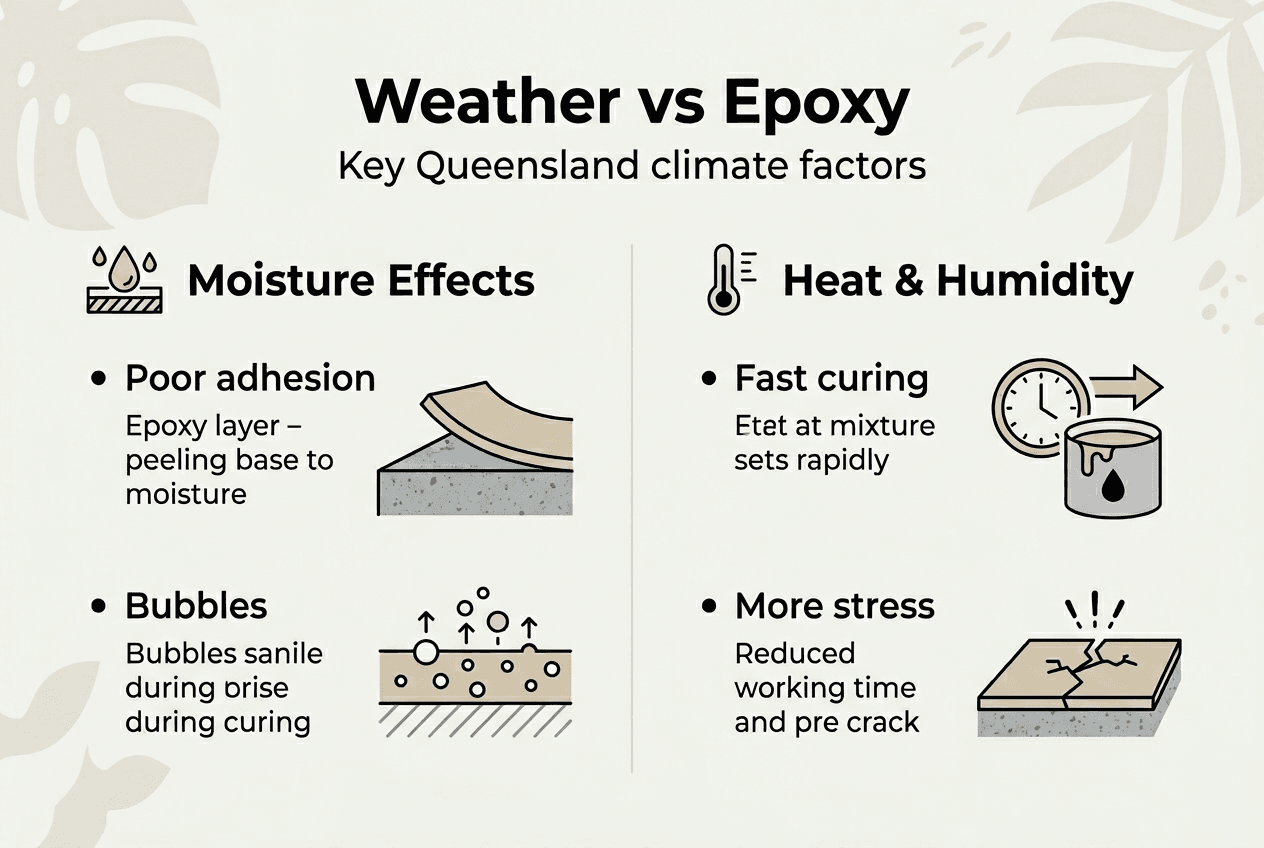
The science behind moisture interference is straightforward. When you apply epoxy over concrete containing excessive moisture, water vapour trapped beneath the coating attempts to escape. This creates osmotic pressure at the bond interface, physically lifting the epoxy away from the substrate. The result manifests as blistering, delamination, and complete adhesion failure within weeks or months of installation.
Research confirms that adhesion failures increase significantly when substrate moisture exceeds 4%. Below this threshold, epoxy penetrates concrete pores effectively and forms strong mechanical bonds. Above 4%, the probability of failure rises exponentially. For Queensland properties, this means concrete slabs exposed to recent rainfall or high groundwater often exceed safe moisture levels.
Symptoms of moisture-related adhesion problems include visible bubbling beneath the epoxy surface, hollow sounds when tapping the floor, peeling edges around expansion joints, and white calcium deposits appearing through the coating. These issues typically emerge 2-8 weeks post-installation as trapped moisture continues migrating upward.
Pro tip: Always conduct calcium chloride moisture tests 72 hours before applying epoxy floor coatings. Place test kits on multiple areas of the concrete slab, seal them, and measure moisture vapour emission rates. If readings exceed 1.4kg per 92 square metres per 24 hours, delay installation until the substrate dries sufficiently.
Timing your epoxy installation to Queensland’s dry winter months from June through September dramatically improves adhesion reliability. During these months, relative humidity drops to 50-65%, rainfall decreases substantially, and concrete slabs naturally release accumulated moisture. Properties with poor drainage or shaded areas may require mechanical dehumidification or moisture barrier primers even during dry periods to achieve optimal substrate conditions.
Impact of temperature and humidity on epoxy curing and stress
Beyond substrate moisture, ambient temperature and relative humidity during the curing process fundamentally alter epoxy’s final mechanical properties. Understanding these effects helps you predict floor performance under Queensland’s warm, humid conditions.
Elastic modulus measures a material’s stiffness or resistance to deformation under stress. Higher elastic modulus values indicate stiffer, less flexible materials. Internal stress refers to forces trapped within the cured epoxy matrix, typically arising from volumetric shrinkage as the material transitions from liquid to solid. Excessive internal stress creates microcracks that compromise durability.
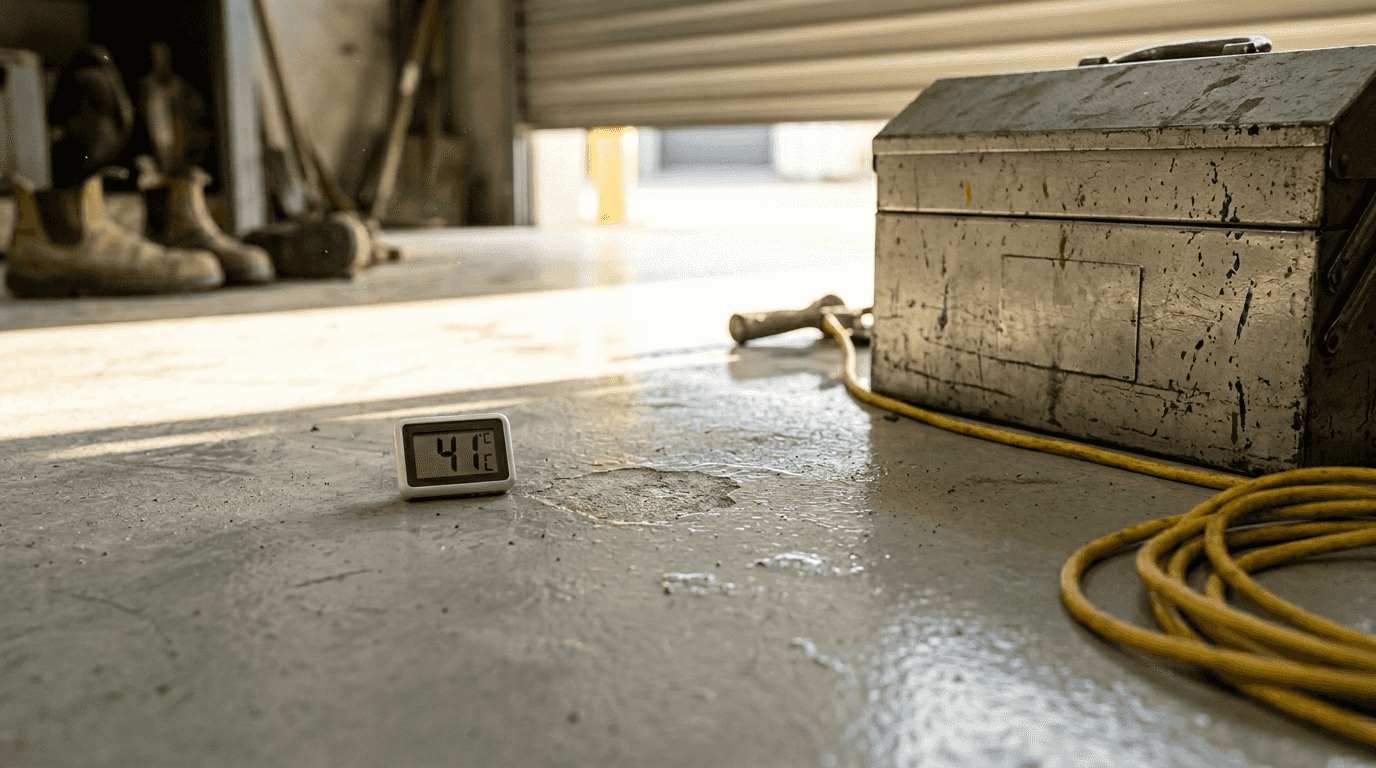
Queensland’s summer temperatures frequently reach 35-45°C in garages, patios, and industrial spaces where epoxy flooring is commonly installed. Research demonstrates that elevated curing temperatures result in smaller elastic modulus and slight increases in internal stress around 0.2 MPa. Translated practically, epoxy cured in Queensland’s summer heat becomes marginally less stiff but experiences higher residual stress, potentially reducing long-term crack resistance.
Relative humidity produces more complex, nonlinear effects. Studies show that increasing humidity from 35% to 60% creates smaller elastic modulus, less volumetric shrinkage, and reduced internal stress—generally favourable outcomes. However, at 90% relative humidity, internal stress paradoxically increases beyond levels observed at 60% RH. This nonlinear relationship means Queensland’s frequently high humidity (70-85% in coastal areas) sits in an unpredictable zone.
| Curing condition | Elastic modulus effect | Internal stress effect | Volumetric shrinkage |
|---|---|---|---|
| Temperature 35-45°C | Decreases slightly | Increases ~0.2 MPa | Minimal change |
| Humidity 35% to 60% | Decreases | Decreases | Decreases |
| Humidity 60% to 90% | Decreases further | Increases unexpectedly | Variable |
| Standard conditions | Baseline | Baseline | Baseline |
For Queensland applications, these findings suggest moderate humidity around 60% creates optimal curing conditions, whilst very high humidity above 80% introduces unpredictable stress patterns. Summer installations face dual challenges: high temperatures reducing elasticity whilst potentially elevated humidity creates variable stress outcomes.
Pro tip: Schedule epoxy applications for early morning hours between 6-9am during Queensland’s cooler months. This timing captures moderate temperatures (18-25°C) and lower humidity before daily peaks, optimising curing conditions. Use dehumidifiers in enclosed spaces when ambient humidity exceeds 70% to maintain control over the curing environment.
The practical implications extend to floor longevity. Epoxy cured under suboptimal conditions may appear perfectly acceptable initially but develops premature surface crazing, reduced chemical resistance, and lower impact tolerance over 3-5 years. Controlling environmental conditions during the critical 24-48 hour curing window pays dividends in extended floor life.
Formulation factors: fillers and solvents influencing performance under varied weather
Epoxy formulation chemistry significantly determines how weather conditions ultimately affect floor performance. Two formulation components deserve particular attention: mineral fillers and solvent content.
Fillers are inert mineral particles added to epoxy resin, commonly barium sulphate (BaSO4) or calcium carbonate (CaCO3). These materials serve multiple purposes: reducing material costs, improving abrasion resistance, adjusting viscosity for easier application, and modifying thermal expansion properties. However, fillers also alter how epoxy responds to environmental conditions during curing.
Research confirms that fillers increase elastic modulus and internal stress whilst reducing volumetric shrinkage. This creates a trade-off: filled epoxies become stiffer and more abrasion-resistant but carry higher residual stresses that may promote cracking under thermal cycling or mechanical shock. For Queensland applications experiencing daily temperature swings of 15-20°C between night and day, this internal stress becomes relevant.
| Filler type | Elastic modulus | Internal stress | Shrinkage | Queensland suitability |
|---|---|---|---|---|
| No filler | Lower (more flexible) | Lower | Higher | Good for thermal cycling |
| BaSO4 filler | Higher (stiffer) | Higher | Lower | Better chemical resistance |
| CaCO3 filler | Moderate increase | Moderate increase | Lower | Cost-effective compromise |
Solvents in epoxy formulations serve as reactive diluents, reducing viscosity for improved substrate penetration and easier application. Interestingly, solvents also dramatically influence final cure quality and internal stress. Data shows that increasing solvent concentration from zero to 20% by volume raises final conversion from 72% to 85% whilst simultaneously decreasing internal stress from 1.25 MPa to 0.6 MPa.
This finding holds particular relevance for Queensland installations. Higher final conversion means more complete chemical crosslinking, producing superior chemical resistance and mechanical strength. Lower internal stress reduces cracking risk. Solvent-modified epoxies therefore offer advantages in challenging weather conditions, though they require longer cure times and adequate ventilation.
Weather influences these formulation effects during application and curing. High humidity slows solvent evaporation, potentially trapping solvents and affecting final film properties. Elevated temperatures accelerate solvent loss, sometimes too rapidly for optimal substrate wetting. Selecting appropriate formulations for Queensland’s climate requires matching chemistry to expected conditions.
Consider these formulation selection guidelines for Queensland weather:
- Choose solvent-modified epoxies for improved cure conversion and stress reduction in variable humidity
- Select moderate filler loadings (10-15% by volume) to balance abrasion resistance against thermal stress tolerance
- Specify calcium carbonate fillers for cost-effective general applications, barium sulphate for chemical exposure areas
- Avoid heavily filled systems for exterior applications experiencing direct sun exposure and extreme temperature cycling
- Request technical data sheets showing cure profiles at 25-35°C and 60-80% RH to match Queensland conditions
Working with suppliers who understand Queensland’s climate helps ensure you receive epoxy formulations optimised for local conditions. Generic products designed for temperate climates may underperform in subtropical environments. When choosing between epoxy and polyurethane, consider that polyurethane topcoats over epoxy base layers can provide UV resistance and flexibility that pure epoxy floor coatings may lack under intense Queensland sun exposure.
Practical tips for epoxy flooring installation and maintenance in Queensland climates
Successful epoxy flooring in Queensland requires methodical preparation, strategic timing, and ongoing maintenance adapted to local weather patterns. Follow these sequential steps for optimal results:
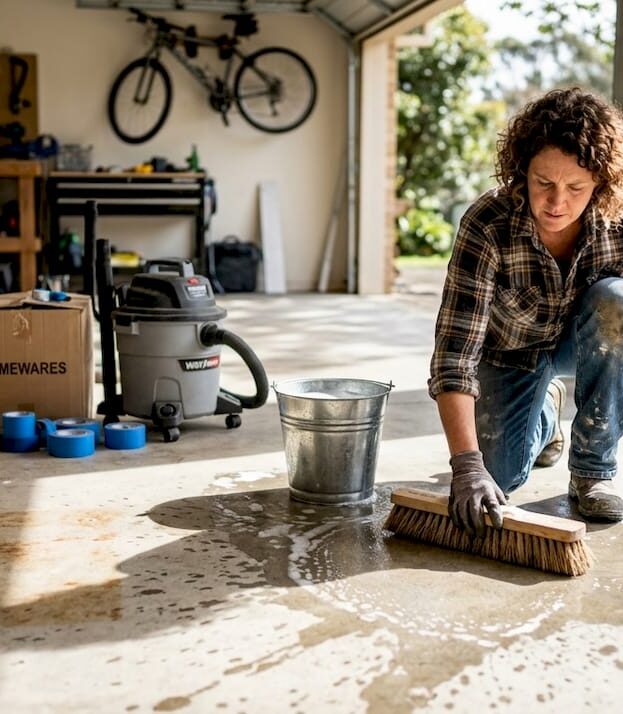
- Conduct thorough moisture testing using calcium chloride kits or electronic moisture metres across the entire concrete surface, paying special attention to areas near drainage or beneath downpipes
- Schedule installation during Queensland’s dry season (June-September) when substrate moisture naturally decreases and humidity remains moderate
- Prepare concrete surfaces through mechanical grinding or shot blasting to achieve CSP-3 profile, ensuring adequate mechanical keying for epoxy penetration
- Clean substrates completely, removing all dust, oils, and contaminants that interfere with adhesion regardless of weather conditions
- Prime concrete with moisture-tolerant primers if moisture readings approach 4% threshold, providing additional insurance against vapour transmission
- Apply epoxy coatings during morning hours when temperatures range 18-25°C and humidity sits below 70% for optimal curing conditions
- Maintain ambient temperatures between 15-30°C for 48 hours post-application using temporary climate control if necessary
- Restrict foot traffic for 24 hours and vehicle traffic for 72 hours minimum, extending cure times during cooler weather
Choosing optimal weather windows requires monitoring Bureau of Meteorology forecasts for 72-hour periods without predicted rainfall. Even brief showers during the initial 24-hour cure can introduce moisture that compromises adhesion. Queensland’s afternoon thunderstorms from November through March make summer installations particularly risky.
Maintenance strategies for Queensland’s climate focus on managing moisture exposure and preventing UV degradation:
- Clean floors weekly during wet season to remove tracked-in mud and standing water that can penetrate coating defects
- Apply UV-resistant topcoats every 3-5 years for exterior or sun-exposed applications to prevent chalking and colour fading
- Repair minor chips or scratches immediately before moisture infiltrates and undermines surrounding areas
- Avoid pressure washing with excessive force that can drive water beneath coating edges
- Maintain proper drainage around exterior epoxy areas to prevent ponding during Queensland’s intense rainfall events
Pro tip: Never begin epoxy installation if rain is forecast within 48 hours, even if current conditions appear perfect. Queensland’s weather can change rapidly, and unexpected rainfall during curing ruins installations. Always build weather contingency into project timelines.
Adhesion failures are significantly more likely when moisture content exceeds 4%, making moisture testing non-negotiable for Queensland installations.
Regular monitoring of weather forecasts becomes part of successful epoxy floor ownership in Queensland. Before undertaking any repair work or recoating, check predicted conditions just as carefully as during initial installation. The epoxy flooring application process demands respect for environmental factors at every stage.
For high-traffic commercial applications, consider that best flooring for high traffic areas often combines epoxy base layers with specialised topcoats or hybrid systems that provide enhanced durability under Queensland’s demanding conditions. Pure epoxy works excellently for many residential and light commercial applications, but heavy industrial environments may benefit from polyurethane or polyaspartic topcoats that cure reliably even in less-than-ideal weather.
Discover professional epoxy flooring solutions for Queensland homes and businesses
Navigating Queensland’s weather challenges requires more than theoretical knowledge. It demands practical experience, quality materials, and proven installation techniques adapted to subtropical conditions. Floor X Industries specialises in epoxy floor coatings engineered specifically for Queensland’s climate, combining over a decade of regional expertise with advanced formulations that perform reliably despite humidity, temperature extremes, and seasonal moisture variations.

Our durable epoxy coatings incorporate moisture-tolerant primers, UV-resistant topcoats, and carefully selected filler systems that balance strength against thermal stress tolerance. Whether you’re planning a residential garage transformation or a commercial warehouse floor upgrade, our team provides comprehensive moisture testing, weather-appropriate scheduling, and installation techniques that account for Queensland’s unique environmental factors. Explore our epoxy flooring application guide for detailed technical information, or contact us directly to discuss your specific project requirements and receive tailored recommendations for optimal results in Queensland’s challenging climate.
FAQ
How does high humidity specifically impact epoxy flooring?
High humidity creates nonlinear effects on epoxy curing. Moderate humidity around 60% actually reduces internal stress and improves outcomes, but very high humidity above 80% paradoxically increases stress and can slow curing. Queensland’s coastal humidity (70-85%) sits in this unpredictable zone, making dehumidification valuable during installation.
Can epoxy flooring be installed during Queensland’s wet season?
Installing during wet season (November-March) carries substantial risk due to elevated concrete moisture causing adhesion failures. If installation cannot wait, conduct rigorous moisture testing, use moisture-barrier primers, and apply only during multi-day dry spells with dehumidification equipment running continuously. Dry season installation (June-September) remains strongly preferable.
How do temperature extremes affect epoxy floor performance?
High temperatures during curing (35-45°C) slightly reduce elasticity and increase internal stress by approximately 0.2 MPa, potentially affecting long-term durability. Queensland’s summer heat makes early morning application essential. Extreme cold rarely occurs in Queensland but would slow curing without significantly harming final properties.
What maintenance can prolong epoxy flooring life in Queensland?
Regular cleaning removes abrasive dirt tracked in during wet weather, preventing premature wear. Avoid harsh alkaline cleaners that degrade epoxy surfaces. Apply UV-resistant topcoats every 3-5 years for sun-exposed areas. Address chips or scratches immediately before moisture infiltrates, and maintain proper drainage to prevent water ponding. Following floor maintenance best practices adapted for epoxy extends service life substantially in Queensland’s demanding climate.