

Warehouse flooring choices often focus on upfront costs, overlooking long-term durability and safety implications. Many facility managers default to epoxy coatings without realising polished concrete delivers superior performance over decades. This guide reveals why polished concrete has become the smart choice for Queensland warehouses in 2026, offering surprising benefits that traditional options simply cannot match.
Table of Contents
- Durability And Maintenance Advantages Of Polished Concrete
- How Polished Concrete Improves Warehouse Safety And Visibility
- The Role Of Densification And Polishing In Enhancing Performance And Appearance
- Choosing Polished Concrete For Your Warehouse: Practical Considerations
- Explore Polished Concrete And Floor Coatings With Floor X Industries
- Frequently Asked Questions
Key takeaways
| Point | Details |
|---|---|
| Durability over 20 years | Polished concrete withstands heavy traffic and chemical spills, reducing repair needs significantly |
| Enhanced safety | Better light reflectivity increases visibility by 30% and reduces dust-related slip hazards |
| Lower lifetime costs | Minimal maintenance eliminates expensive re-coating cycles required by epoxy every 5-7 years |
| Densification benefits | Surface hardness increases by 40%, extending floor lifespan under demanding warehouse conditions |
| Customisable performance | Aggregate selection and polishing levels balance aesthetics with slip resistance requirements |
Durability and maintenance advantages of polished concrete
Warehouse floors endure relentless punishment from forklifts, pallet jacks, and chemical spills. Mechanically polished concrete withstands heavy forklift traffic, impact, and chemical spills, lasting 10-20+ years, while epoxy typically degrades within 5-7 years under similar conditions. This stark difference stems from polished concrete’s inherent structural integrity rather than relying on surface coatings that chip and wear.
Epoxy floor coatings create an attractive finish initially, but warehouse operations quickly reveal their limitations. Heavy vehicle traffic causes delamination, especially where moisture issues exist beneath the surface. Chemical spills penetrate worn areas, requiring expensive spot repairs or complete re-coating. Polished concrete significantly reduces repair needs, offering 20+ years of reliable service without these recurring headaches.
Maintenance requirements differ dramatically between these flooring options. Polished concrete needs only regular sweeping and occasional wet mopping to maintain its appearance and performance. No re-coating, no downtime for repairs, no chemical strippers required. Epoxy demands protective measures, periodic deep cleaning, and eventual replacement that disrupts warehouse operations for days.
Lifecycle cost analysis reveals polished concrete’s financial advantage despite higher installation costs. Consider a 5,000 square metre warehouse over 20 years:
| Flooring type | Initial cost | Maintenance frequency | Re-coating cycles | Total 20-year cost |
|---|---|---|---|---|
| Polished concrete | $150,000 | Monthly sweeping | None | $165,000 |
| Epoxy coating | $95,000 | Weekly deep clean | 3 full re-coats | $245,000 |
| Standard concrete | $75,000 | Daily dust control | Annual sealing | $195,000 |
The numbers speak clearly when you factor in operational disruptions and lost productivity during re-coating projects. Epoxy installations require 3-5 days of downtime per cycle, multiplied across multiple re-coats over two decades.
Pro tip: Assess your concrete slab condition thoroughly before polishing to identify cracks, moisture issues, or structural weaknesses that could compromise longevity and require costly repairs later.
Choosing between epoxy floor coatings and polished concrete depends on your operational priorities. Warehouses prioritising long-term value and minimal disruption find polished concrete delivers superior returns. Those seeking decorative options might explore the hyper flake stone range for combining aesthetics with durability.
How polished concrete improves warehouse safety and visibility
Warehouse accidents often trace back to poor visibility and slippery surfaces. Polished concrete increases ambient light levels by up to 30%, transforming dimly lit aisles into well-illuminated workspaces. This reflective quality reduces electrical costs while simultaneously improving employee safety through better hazard visibility.

Dust accumulation creates multiple hazards in warehouse environments. It settles on products, damages equipment, and creates respiratory health risks for workers. Polished concrete reduces dust accumulation by sealing the surface at a molecular level, preventing concrete particles from breaking free under traffic. Less dust means fewer slip hazards when moisture combines with fine particles to create treacherous walking surfaces.
Slip resistance becomes critical in areas prone to spills or condensation. Surface sealers applied during the polishing process can be formulated to enhance traction without sacrificing the floor’s reflective properties. This balance proves especially important near loading docks, refrigerated zones, and chemical storage areas where moisture regularly contacts flooring.
Safety benefits extend beyond the obvious:
- Improved forklift operator sightlines reduce collision risks with pedestrians and racking systems
- Reduced dust inhalation protects worker respiratory health and lowers absenteeism
- Easier spill identification allows faster cleanup before accidents occur
- Consistent surface texture eliminates trip hazards from uneven coatings or patches
- Better lighting reduces eye strain during detailed picking and packing operations
“Polished concrete floors transformed our warehouse safety metrics. Reported slip incidents dropped 60% in the first year, and our lighting costs fell by nearly a third. The reflective surface means our team spots spills immediately, preventing accidents before they happen.” — Operations Manager, Brisbane Distribution Centre
Maintaining these safety advantages requires minimal effort compared to alternative flooring systems. Regular sweeping removes debris that could reduce traction. Periodic inspections identify areas needing sealer reapplication, typically every 3-5 years depending on traffic intensity.
Pro tip: Maintain sealers regularly in high-traffic zones to preserve slip resistance and dust protection, scheduling reapplication during low-activity periods to avoid operational disruptions.
Concrete polishing services deliver these safety improvements through systematic surface preparation and finishing. Understanding the technical process helps facility managers make informed decisions about specifications and performance expectations. Proper implementation requires expertise that goes beyond basic concrete work, particularly when integrating warehouse pest control measures that rely on sealed, crack-free surfaces to prevent infestations.
The role of densification and polishing in enhancing performance and appearance
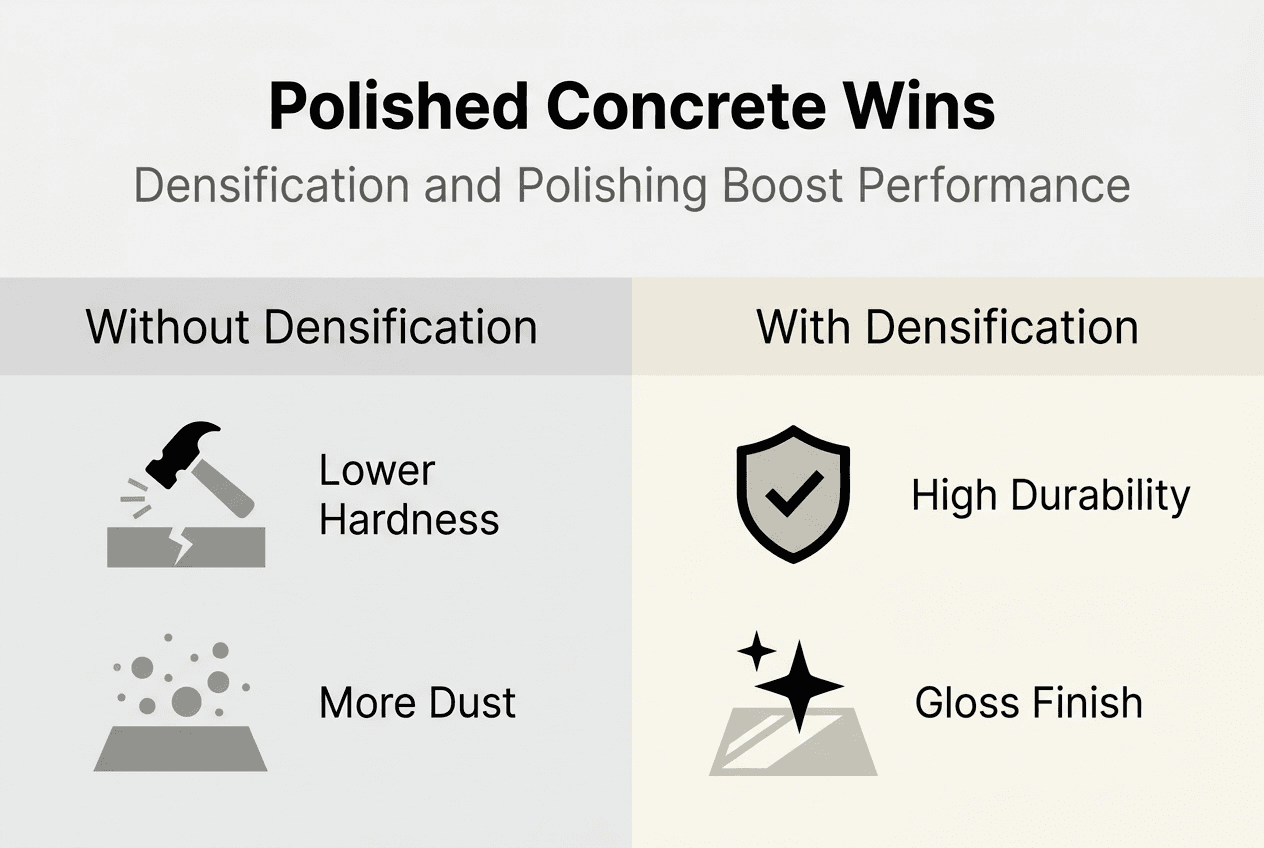
Densification fundamentally transforms concrete’s molecular structure, creating performance characteristics impossible with surface coatings alone. Densifiers increase concrete compressive strength by up to 30% and abrasion resistance by 40%, turning ordinary slabs into industrial-grade surfaces capable of withstanding decades of punishment.
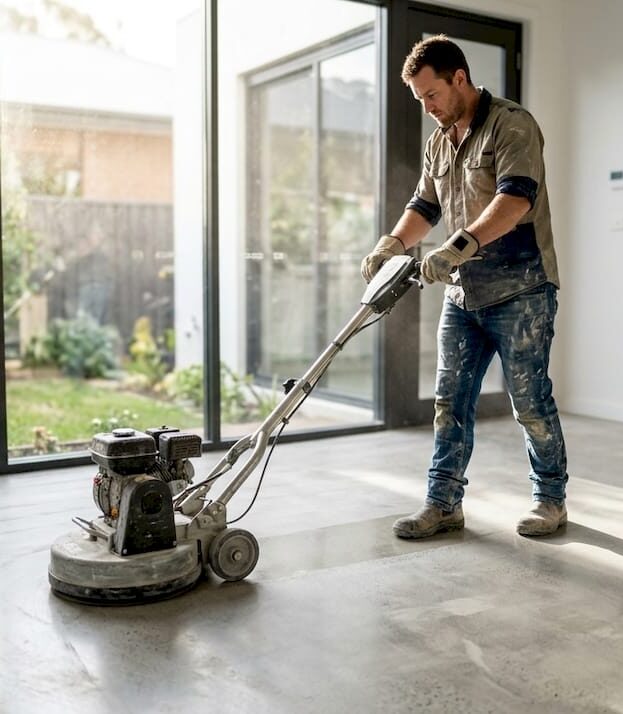
The polishing process follows a systematic progression that builds upon each previous step:
- Surface preparation removes existing coatings, adhesives, and contaminants that would interfere with densifier penetration
- Coarse grinding with 30-50 grit diamond tooling exposes aggregate and creates a uniform surface profile
- Medium grinding progresses through 80-120 grit diamonds, refining the surface and removing deeper scratches
- Densification applies lithium silicate solutions that penetrate 3-5mm deep, chemically reacting with calcium hydroxide to form calcium silicate hydrate crystals
- Fine polishing uses 200-400 grit diamonds after densifier curing, developing initial gloss and hardness
- Final polishing employs 800-3000 grit diamonds to achieve specified gloss levels and maximum surface density
Densification’s chemical reaction fundamentally differs from topical sealers that simply coat the surface. The process fills microscopic pores within the concrete matrix, creating a barrier against moisture, chemicals, and abrasion from within the slab itself. This internal strengthening explains why polished concrete maintains performance even as surface wear occurs over years of heavy use.
Comparing densified versus non-densified polished concrete reveals dramatic performance differences:
| Performance metric | Without densification | With densification | Improvement |
|---|---|---|---|
| Surface hardness (Mohs scale) | 4-5 | 7-8 | 60% harder |
| Gloss retention (5 years) | 45% | 85% | 89% better |
| Abrasion resistance | Moderate | Excellent | 40% increase |
| Chemical resistance | Fair | Very good | Significant |
| Moisture penetration | 8mm depth | 0.5mm depth | 94% reduction |
Aggregate choice and polishing grit impact final gloss, hardness, and slip resistance significantly. Granite aggregate offers superior hardness compared to limestone, producing floors that resist wear more effectively under forklift traffic. Basalt provides excellent durability with attractive dark tones. Quartz delivers both hardness and visual interest through varied colours and textures.
Polishing grit selection determines the final appearance and functionality. Stopping at 400 grit produces a satin finish with good slip resistance, ideal for areas where traction outweighs aesthetics. Progressing to 1500-3000 grit creates a high-gloss mirror finish that maximises light reflectivity but may reduce traction on inclines or wet areas.
Pro tip: Consult with concrete polishing specialists about selecting polishing grits and aggregates tailored to your specific warehouse needs, balancing aesthetic preferences with safety requirements and traffic patterns.
Avoiding common mistakes during grinding prevents visual defects that become permanent after final polishing. Early cross-cutting creates scratch patterns that telegraph through subsequent polishing steps, visible as geometric patterns in the finished floor. Inconsistent grinding pressure produces uneven aggregate exposure, creating a blotchy appearance. Premature densifier application before adequate grinding traps contaminants and prevents proper chemical reaction.
Honed concrete finishes offer an alternative to full polishing, stopping at medium grits for a matte appearance with excellent durability. This approach suits warehouses prioritising function over high-gloss aesthetics. Understanding densification benefits helps facility managers specify appropriate finishing levels for different operational zones within the same facility.
Choosing polished concrete for your warehouse: practical considerations
Successful polished concrete installation begins long before diamond tooling touches your warehouse floor. Proper preparation determines whether your investment delivers decades of service or disappointing performance requiring premature replacement.
Critical preparation steps include:
- Crack filling with epoxy or polyurea compounds rated for structural movement and thermal expansion
- Comprehensive slab assessment identifying hollow spots, delamination, and previous repair areas
- Moisture testing using calcium chloride tests or relative humidity probes to detect vapour transmission issues
- Joint evaluation determining if existing control joints need routing, filling, or semi-dry cutting
- Surface contamination removal addressing oils, adhesives, or coatings that prevent densifier penetration
- Structural load testing in areas supporting heavy racking or concentrated equipment loads
Proper surface preparation including crack repair and slab integrity assessment proves critical for long-term success. Skipping moisture testing can lead to catastrophic failures where hydrostatic pressure eventually delaminates the densified surface layer. Inadequate crack repair allows movement that propagates fractures through the polished surface.
Selecting experienced contractors separates successful projects from costly disappointments. Look for specialists demonstrating:
- Portfolio showing similar warehouse-scale projects with verifiable references
- Equipment capability including planetary grinders for large areas and edge grinders for perimeter work
- Knowledge of Australian standards for concrete finishing and workplace safety compliance
- Clear methodology for handling unexpected conditions like embedded metal or utility penetrations
- Warranty coverage specifying performance standards and remediation processes
Maintenance requirements remain minimal but shouldn’t be ignored entirely. Regular sweeping removes abrasive particles that gradually dull the surface despite its hardness. Wet mopping with pH-neutral cleaners prevents residue buildup that clouds the finish. Periodic inspections identify high-wear zones needing sealer reapplication before damage penetrates deeper.
Potential challenges require proactive planning. Avoiding early cross-cutting during grinding prevents permanent visual defects in the finished floor. Selecting appropriate diamond tooling hardness for your specific aggregate type ensures efficient material removal without excessive tool wear. Coordinating work schedules around warehouse operations minimises disruption while allowing adequate cure times between process steps.
Aggregate selection and polish level balance competing priorities. Exposed aggregate provides maximum slip resistance and visual interest but requires more grinding time and cost. Cream finishes polish faster and cheaper but offer less character and slightly lower abrasion resistance. Your operational requirements should drive these decisions rather than aesthetic preferences alone.
Scheduling flooring upgrades during low-traffic periods protects your investment and maintains productivity. Many warehouses phase installations by zone, completing work during nights or weekends to avoid operational shutdowns. This approach costs more in labour but preserves revenue-generating activities. Alternatively, complete facility closures during slow seasonal periods allow faster, more economical installations.
Industrial floor coating services extend beyond polished concrete to include specialised solutions for unique operational requirements. Understanding the full range of industrial flooring options helps facility managers specify appropriate systems for different warehouse zones, combining polished concrete in main traffic areas with epoxy coatings in chemical storage or food preparation zones.
Explore polished concrete and floor coatings with Floor X Industries
Warehouse flooring demands expertise that goes beyond residential or light commercial applications. Floor X Industries brings over a decade of specialised experience to Queensland warehouses, delivering polished concrete installations engineered for heavy industrial use. Our team understands the unique challenges of maintaining operations while upgrading critical infrastructure.

Beyond polished concrete, we offer comprehensive flooring solutions including epoxy coatings for chemical resistance and decorative Hyper Flake Stone finishes combining durability with visual appeal. Every project receives customised specifications matching your operational requirements, traffic patterns, and budget constraints. Contact Floor X Industries today to discuss how durable, safe, low-maintenance flooring transforms warehouse performance and reduces lifecycle costs.
Frequently asked questions
What is mechanically polished concrete and how does it differ from regular concrete?
Mechanically polished concrete uses diamond abrasives to grind and polish the surface, creating a hard, dense, reflective finish. Unlike regular concrete that remains porous and prone to dusting, polished concrete undergoes densification that chemically hardens the surface and seals microscopic pores. This process transforms ordinary slabs into high-performance floors resistant to abrasion, chemicals, and moisture penetration.
How long does a polished concrete warehouse floor typically last?
Properly installed and maintained polished concrete floors deliver 20+ years of service in demanding warehouse environments. This lifespan significantly exceeds epoxy coatings requiring replacement every 5-7 years under similar traffic conditions. The densification process creates permanent molecular changes that don’t wear away like surface coatings, ensuring long-term performance even under heavy forklift traffic and chemical exposure.
Is polished concrete safe for forklift traffic and heavy equipment?
Polished concrete with densification excels under forklift traffic and heavy equipment operations. The hardened surface resists impact damage, abrasion from turning tyres, and point loads from racking systems without cracking or spalling. Proper aggregate selection and polishing specifications create slip-resistant surfaces that maintain traction even in areas experiencing occasional moisture, protecting both equipment and personnel during normal warehouse operations.
What maintenance is required to keep polished concrete floors in top condition?
Routine maintenance involves regular sweeping to remove abrasive debris and periodic wet mopping with pH-neutral cleaners. Unlike epoxy requiring re-coating every few years, polished concrete needs only occasional sealer reapplication in high-traffic zones every 3-5 years. This minimal maintenance schedule reduces operational disruptions and lifecycle costs while maintaining the floor’s appearance and performance characteristics throughout its 20+ year lifespan.