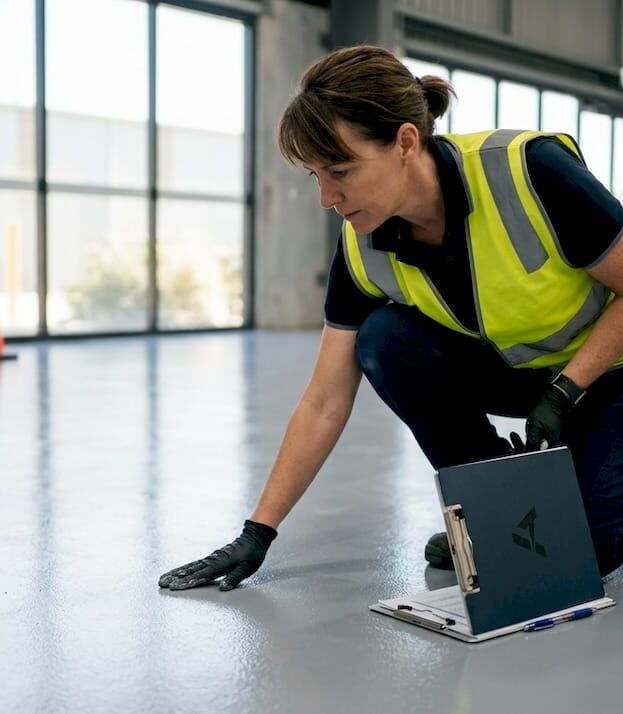


Many Queenslanders assume tiles or bare concrete are the gold standard for durable flooring. It’s a reasonable assumption, but it overlooks a critical reality: both options demand ongoing maintenance, struggle with Queensland’s humidity, and can cost significantly more over time. Resin floors, by contrast, deliver a seamless, long-lasting surface that handles the local climate with ease. In this guide, we cover everything you need to know about resin flooring, from how it works and what it costs, to installation essentials and care routines, so you can make a confident, well-informed decision for your property.
Table of Contents
- What are resin floors and how do they work?
- Top reasons to invest in resin flooring for Queensland properties
- How much do resin floors cost? What impacts value over time?
- Common applications: Where resin floors add most value
- Installing resin floors: What Queenslanders must know
- Caring for your resin floors: Maintenance tips for years of value
- Ready to upgrade? Get expert resin flooring for lasting value
- Frequently asked questions
Key Takeaways
| Point | Details |
|---|---|
| Long-term durability | Resin floors can last 10–20 years with minimal maintenance, outlasting many traditional floors. |
| Low maintenance costs | Professional resin floors require little cleaning and save money over time compared to tiles or concrete. |
| Custom style options | Choose from a variety of colours, finishes, and textures to match any home or business. |
| Climate-ready performance | Modern resin floors excel in Queensland’s humidity and sun with the correct topcoat and installation. |
What are resin floors and how do they work?
Now that we’ve set the scene for your flooring choices, let’s explore exactly what makes a resin floor unique and how it functions in practice.
Resin flooring is a liquid-applied polymer system that cures into a seamless, hard-wearing surface directly over your existing concrete slab. Unlike tiles or timber, there are no grout lines, no joints, and no weak points where moisture or bacteria can accumulate. You get one continuous, bonded surface that performs consistently across the entire floor area.
The most common types include:
- Epoxy resin: A two-part system combining resin and hardener. Extremely durable, chemical-resistant, and ideal for garages, warehouses, and commercial floors.
- Polyurethane (PU) resin: More flexible than epoxy and better suited to areas with temperature fluctuation or foot traffic. Often used as a topcoat over epoxy for added UV resistance.
- Decorative systems: Incorporate colour flakes, metallic pigments, or quartz aggregate for visual appeal alongside performance.
Understanding how resin flooring works helps you appreciate why the installation process matters so much. A standard system involves surface preparation (grinding and profiling the concrete), a primer coat, a base coat, decorative elements if required, and a protective topcoat. Installation involves rigorous surface preparation, specific layers, and curing times ranging from 12 to 72 hours depending on the system and conditions.
Expert note: In Queensland’s subtropical climate, using the correct resin system and ensuring professional installation is non-negotiable. Humidity, temperature, and slab moisture all affect adhesion and long-term performance. Cutting corners on materials or prep work leads to peeling, bubbling, and premature failure.
Top reasons to invest in resin flooring for Queensland properties
Understanding how resin floors are made, let’s examine why they stand out as a smart investment, especially in Queensland’s unique climate.
Resin floors offer a combination of performance benefits that traditional flooring simply cannot match in this environment. Here’s what sets them apart:
- Longevity: A professionally installed resin floor lasts 10 to 20 years with minimal upkeep, far outlasting most tile or painted concrete alternatives.
- All-weather performance: Resin resists Queensland’s high humidity, heavy rain, UV exposure (with the right topcoat), chemical spills, and impact.
- Seamless hygiene: No grout lines means no mould, no bacteria traps, and no stubborn staining. This is especially valuable in kitchens, bathrooms, and food prep areas.
- Design flexibility: Choose from solid colours, metallic finishes, decorative flake systems, or stone-look coatings. The garage epoxy benefits alone make it a popular upgrade for Queensland homeowners.
- Cost effectiveness: Professional resin floors cost more upfront but much less over time than tiles or bare concrete, due to lower maintenance costs.
The upfront investment typically ranges from $20 to $110 per square metre, depending on the system and finish selected. That range reflects everything from a basic single-coat epoxy to a full decorative polyurethane system with flakes and a UV-stable topcoat.
Pro Tip: Always specify a UV-stable polyurethane topcoat for any sun-exposed areas in Queensland. Without it, standard epoxy will yellow and chalk within 12 to 18 months of direct sunlight exposure.
How much do resin floors cost? What impacts value over time?
With benefits in mind, it’s important to consider costs, not just upfront, but long-term. Here’s how resin compares.
| Floor type | Upfront cost (per m²) | Annual maintenance | Expected lifespan | Total cost over 10 years (per m²) |
|---|---|---|---|---|
| Resin (epoxy/PU) | $20 to $110 | Very low | 10 to 20 years | Low to moderate |
| Ceramic tiles | $30 to $90 | Moderate (grout, cracking) | 10 to 15 years | Moderate to high |
| Bare/sealed concrete | $5 to $30 | Moderate (resealing, staining) | 5 to 10 years | Moderate |
Several factors influence where your project lands within the resin price range:
- Substrate condition: Heavily damaged or contaminated slabs require more preparation work, which adds to cost.
- Resin type: Polyurethane systems generally cost more than standard epoxy but offer superior flexibility and UV resistance.
- Decorative finishes: Metallic pigments, quartz broadcast, or multi-layer flake systems increase material and labour costs.
- Floor size and access: Larger areas benefit from economies of scale; tight or complex spaces take more time.
Resin floors range from $20 to $110 per square metre, with professional installation reducing lifecycle maintenance costs considerably. The real value is in what you don’t spend: no regrouting, no resealing every few years, and no replacing cracked tiles. Professional installation is the single most important factor in protecting that value long-term.
Common applications: Where resin floors add most value
Knowing the investment stacks up, let’s pinpoint where resin floors truly shine on Queensland properties.
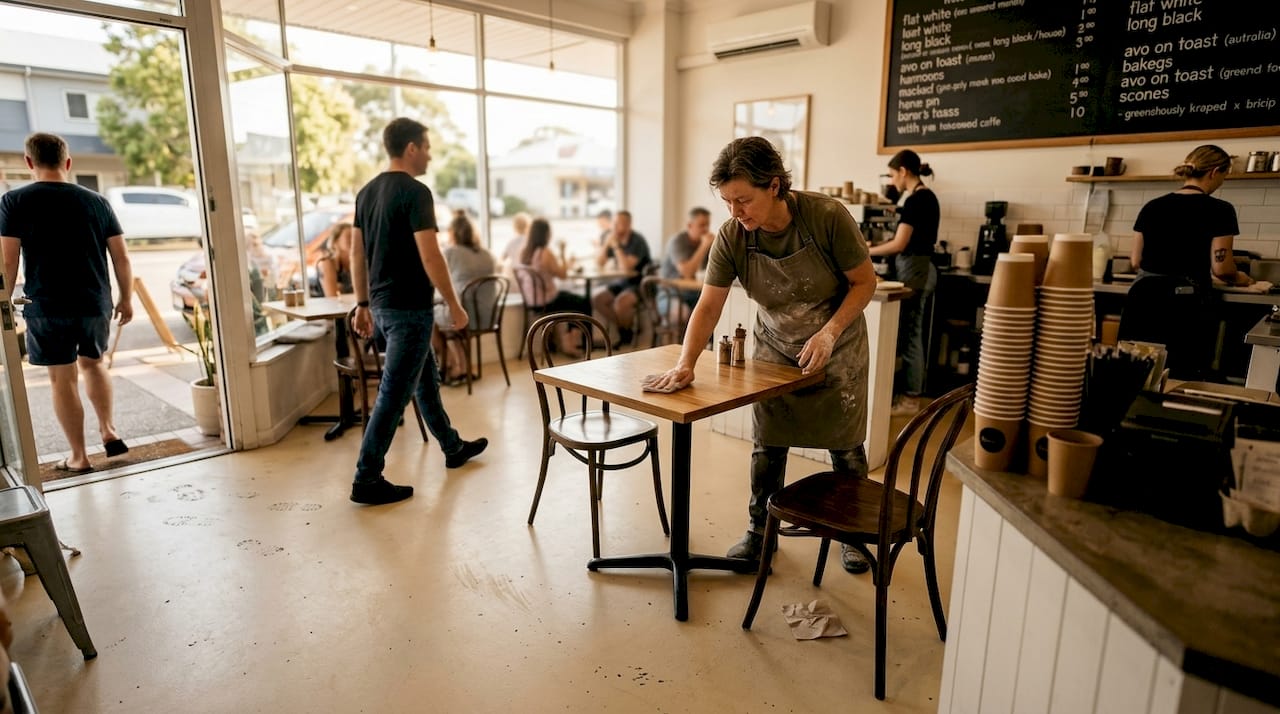
Resin is ideal for garages, showrooms, wet areas, and industrial sites, especially with professional installation. The versatility of the system means it adapts to both residential and commercial demands.
Residential applications:
- Garages and carports
- Kitchens and laundries
- Patios and alfresco areas
- Bathrooms and wet rooms
Commercial and industrial applications:
- Car showrooms and dealerships
- Warehouses and distribution centres
- Food preparation and commercial kitchens
- Retail showrooms and hospitality venues
| Application area | Key performance benefit |
|---|---|
| Garage/carport | Chemical resistance, impact resistance |
| Wet areas (bathroom, kitchen) | Seamless, waterproof, hygienic |
| Patio/alfresco | UV stability, slip resistance |
| Warehouse/industrial | Heavy load capacity, durability |
| Retail/showroom | Aesthetic appeal, easy cleaning |
| Food prep/commercial kitchen | Hygienic, chemical resistant |
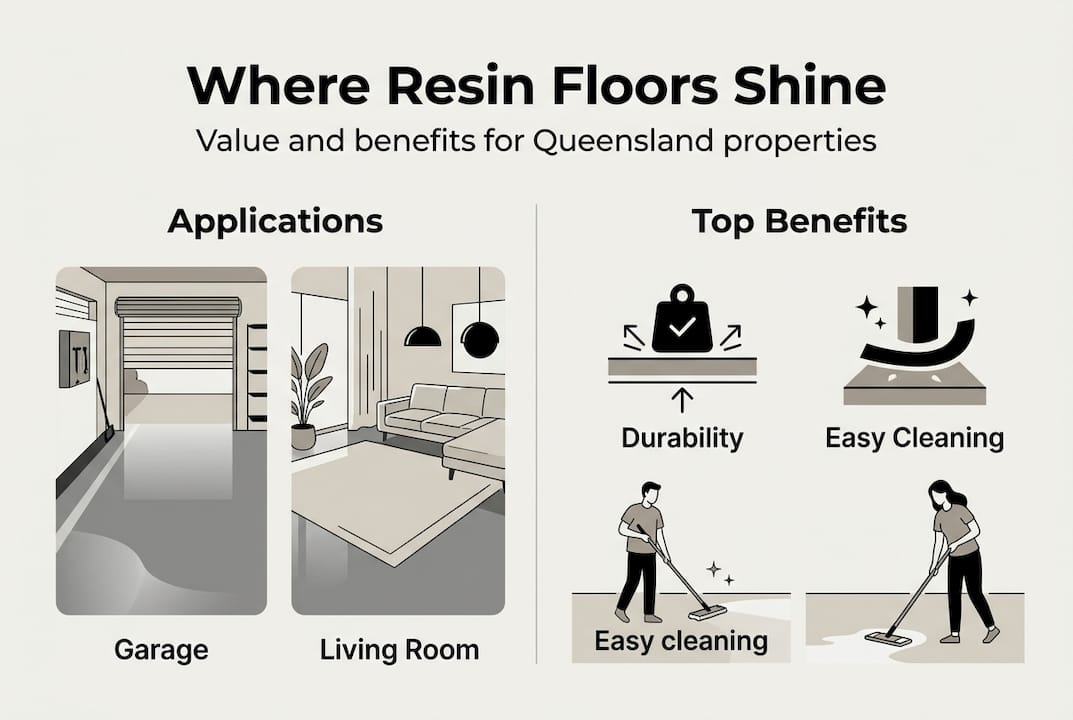
For commercial settings, we recommend specifying a thicker, higher-grade system. A standard residential epoxy at 2 to 3mm may not withstand forklift traffic or chemical exposure in an industrial environment. Explore your options for styling resin flooring to find the right finish for your specific space.
When selecting your resin approach, consider:
- The primary function of the space (foot traffic, vehicle traffic, chemical exposure)
- Whether UV exposure is a factor
- The level of slip resistance required
- Your aesthetic priorities and budget
Installing resin floors: What Queenslanders must know
Found the right area for your resin floor? Here’s what it takes, from prep to a flawless finish.
Installation quality determines how long your floor lasts and how well it performs. Proper surface preparation, especially moisture testing, is essential before installing resin floors. Here are the key steps involved:
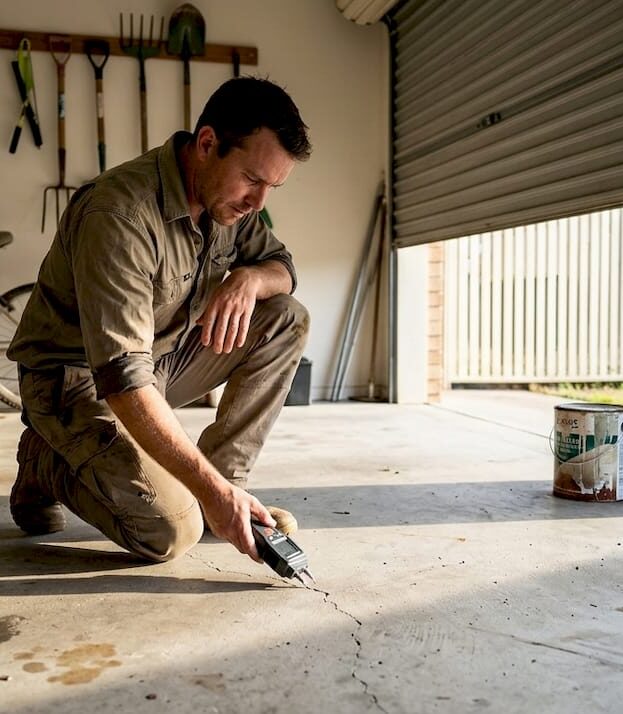
- Site inspection: Assess the existing slab for cracks, contamination, and structural integrity.
- Moisture testing: Measure slab moisture content using a calibrated meter. Readings must be below 4% for most resin systems.
- Surface preparation: Diamond grind or shot-blast the concrete to achieve the correct Concrete Surface Profile (CSP), which ensures mechanical adhesion.
- Priming: Apply a penetrating primer to seal the slab and prevent outgassing (air bubbles rising through the resin).
- Base coat application: Apply the primary resin layer, incorporating colour or decorative elements as required.
- Decorative layer (if applicable): Broadcast flakes, metallic pigments, or quartz aggregate into the wet base coat.
- Topcoat application: Seal with a clear polyurethane or epoxy topcoat for protection and sheen.
- Curing: Allow 12 to 72 hours depending on the system before foot traffic, and up to 7 days for full vehicle load.
For decorative resin floor installation, the layering process requires precision timing between coats. In Queensland’s warmer months, pot life (the working time of mixed resin) shortens, so experienced installers adjust their technique accordingly.
Pro Tip: Always test for slab moisture before committing to a resin system. A reading above 4% requires a moisture-tolerant primer or a vapour barrier system. Skipping this step in Queensland’s humid conditions is the leading cause of resin floor delamination and bubbling.
Caring for your resin floors: Maintenance tips for years of value
Once installed, resin floors are a breeze to care for. Here’s how to protect your investment into the future.
Resin floors have low maintenance requirements, simple cleaning, no grout lines, and straightforward minor repairs. A consistent routine keeps your floor looking sharp for years. Follow these practical guidelines:
- Daily or weekly sweeping: Use a soft broom or dust mop to remove grit and debris. Abrasive particles underfoot act like sandpaper on the topcoat over time.
- Mopping: A mild pH-neutral detergent diluted in warm water is all you need. Avoid acidic or solvent-based cleaners, which can dull or damage the finish.
- Spill management: Wipe up oil, fuel, or chemical spills promptly. Resin is resistant, but prolonged exposure to harsh chemicals can degrade the topcoat.
- Protect against sharp objects: Avoid dragging metal furniture, tools, or equipment across the surface. Use felt pads under furniture legs.
- Recoating: If the topcoat shows wear in high-traffic zones, a professional recoat restores the surface without replacing the entire floor system. This is far more cost-effective than full replacement.
For guidance on long-term care, our resin floor maintenance guide covers everything from routine cleaning to identifying when a professional repair is warranted. Small scuffs and surface scratches can often be addressed with a DIY touch-up kit, but deeper damage or delamination should always be assessed and repaired by a professional to preserve the floor’s integrity.
Ready to upgrade? Get expert resin flooring for lasting value
Equipped with the facts, why not partner with Queensland experts to transform your floors into a lasting, stylish asset?
At Floor X Industries, we bring over a decade of hands-on experience delivering premium resin, epoxy, and polyurethane flooring solutions across Queensland. Whether you’re upgrading a residential garage, fitting out a commercial kitchen, or resurfacing a warehouse floor, our team tailors every system to your specific substrate, environment, and performance requirements.

We offer a full range of finishes, from clean solid colours to decorative flake and metallic systems, with clear timelines and transparent pricing from the first consultation. Our epoxy floor coatings service covers everything from surface preparation through to final topcoat, all compliant with Australian standards. Ready to see what’s possible? Explore epoxy coating options or contact our team today for a no-obligation quote tailored to your property.
Frequently asked questions
How long does a resin floor installation take?
Depending on floor size and conditions, resin installations typically take 2 to 4 days including curing. Curing times vary from 12 to 72 hours per coat, with full vehicle load capacity reached after approximately 7 days.
Can resin floors handle Queensland’s sun and humidity?
Yes, with the right UV-stable topcoat and proper installation, resin floors resist sun damage and humidity effectively. Moisture testing and UV topcoats are essential for Queensland conditions and should never be skipped.
Are resin floors slippery when wet?
Resin floors can be made slip-resistant by incorporating anti-slip flakes, quartz aggregate, or additives into the topcoat during installation. This is a standard option we recommend for patios, bathrooms, and commercial kitchens.
Is resin suitable for kitchens and bathrooms?
Absolutely. Resin floors are seamless and water-resistant, making them an excellent choice for wet areas when the correct system and finish are specified. The absence of grout lines also makes them far more hygienic than tiled alternatives.
What’s the best way to clean resin floors?
Simply sweep regularly and mop with a gentle, pH-neutral cleaner diluted in warm water. Resin floors require simple cleaning and low maintenance, and you should avoid harsh chemicals, abrasive scrubbers, or high-pressure steam cleaning.