

TL;DR:
- Polished concrete offers a lifespan of over 20 years with minimal maintenance, making it cost-effective long-term.
- Epoxy coatings excel in chemical resistance and aesthetic options but require periodic recoating every 5-10 years.
- Choosing floors based solely on initial cost often overlooks higher lifetime expenses, especially in Queensland’s humid climate.
Choosing the wrong industrial floor for your Queensland facility is a costly mistake that goes far beyond aesthetics. The floor you install today will directly affect workplace safety, cleaning schedules, maintenance budgets, and how your space looks to clients and staff for years to come. Queensland’s humid subtropical climate, heavy operational demands, and diverse industry mix create specific challenges that generic flooring guides simply don’t address. This article walks you through the key selection criteria, a detailed look at the two leading options, polished concrete and epoxy coatings, and a direct comparison to help you make a confident, informed decision.
Table of Contents
- How to evaluate industrial flooring for your Queensland facility
- Polished concrete: Long-term value and minimal fuss
- Epoxy coatings: Chemical-proof and visually versatile
- Polished concrete vs. epoxy: Direct comparison for Queensland businesses
- Why most businesses overlook lifetime cost when choosing floors
- Ready to upgrade? Expert help for industrial floors in Queensland
- Frequently asked questions
Key Takeaways
| Point | Details |
|---|---|
| Prioritise lifetime value | Many industrial flooring decisions overlook maintenance and total cost over time. |
| Match flooring to usage | Choose polished concrete for dry, high-traffic areas and epoxy for sites exposed to chemicals or frequent impacts. |
| Aesthetics and safety matter | Modern industrial floors can be both visually impressive and easy to clean while meeting heavy-duty safety requirements. |
| Queensland factors | Climate and local usage patterns should guide both material and finish selection for best performance. |
How to evaluate industrial flooring for your Queensland facility
Having recognised the importance of choosing wisely, let’s look at what really matters when comparing flooring options. Not all industrial floors are created equal, and the criteria you use to evaluate them should reflect your specific facility, operations, and long-term goals.
Start with traffic volume and load type. A warehouse running forklifts and pallet jacks all day needs a fundamentally different surface than a medical fit-out or a retail showroom. Heavy point loads, constant wheeled traffic, and dragging equipment all degrade flooring differently. Knowing your traffic patterns upfront will narrow your options quickly.
Chemical exposure is another non-negotiable factor. If your facility handles oils, solvents, cleaning agents, or food-grade acids, your floor needs to resist penetration and staining. A surface that absorbs chemicals becomes a hygiene risk and a structural liability over time.
Here are the core criteria every Queensland facility manager should assess before committing to a floor:
- Durability and lifespan: How long will it perform without significant degradation?
- Chemical and moisture resistance: Can it handle spills, humidity, and cleaning chemicals?
- Maintenance requirements: How often does it need resealing, recoating, or grinding?
- Upfront vs. lifecycle cost: What is the total spend over 10 to 20 years, not just installation?
- Aesthetic flexibility: Does it need to meet a brand standard or visual requirement?
- Environmental impact: Does it align with your sustainability commitments?
Queensland’s climate adds a layer of complexity. High humidity can affect adhesion during installation, and thermal expansion from temperature swings can stress floor coatings over time. Selecting the right industrial floor coatings means accounting for these local conditions, not just standard performance specs.
Lifecycle cost is where most facility managers get caught out. A floor that costs less to install but requires recoating every five years will almost always cost more over a 20-year period than a higher-upfront option with minimal ongoing maintenance. Factor in the cost of business downtime during recoating, and the gap widens further.
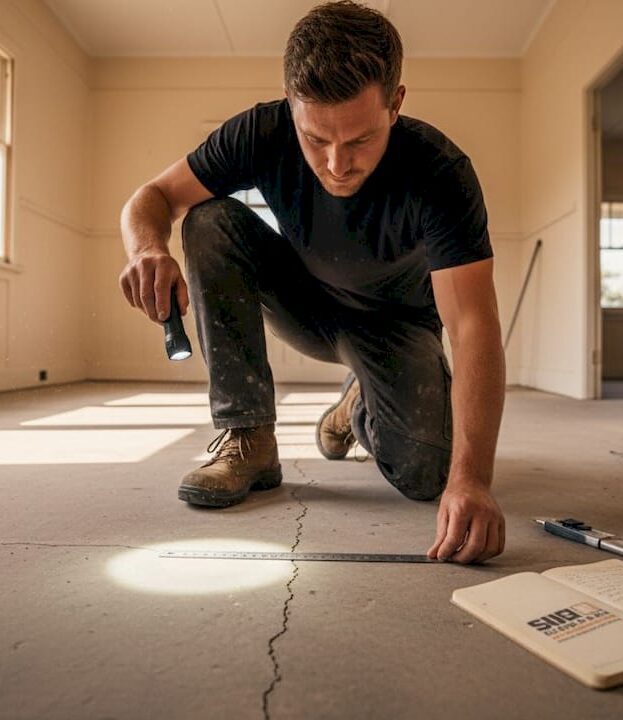
Pro Tip: Before requesting quotes, document your floor’s current condition, the chemicals used in your facility, and your average daily foot and vehicle traffic. This gives any flooring specialist the information they need to recommend the right system, not just the cheapest one.
Polished concrete: Long-term value and minimal fuss
Once you know your criteria, let’s start with one of the most durable choices: polished concrete. This option has grown significantly in popularity across Queensland warehouses, distribution centres, and commercial spaces, and for good reason.
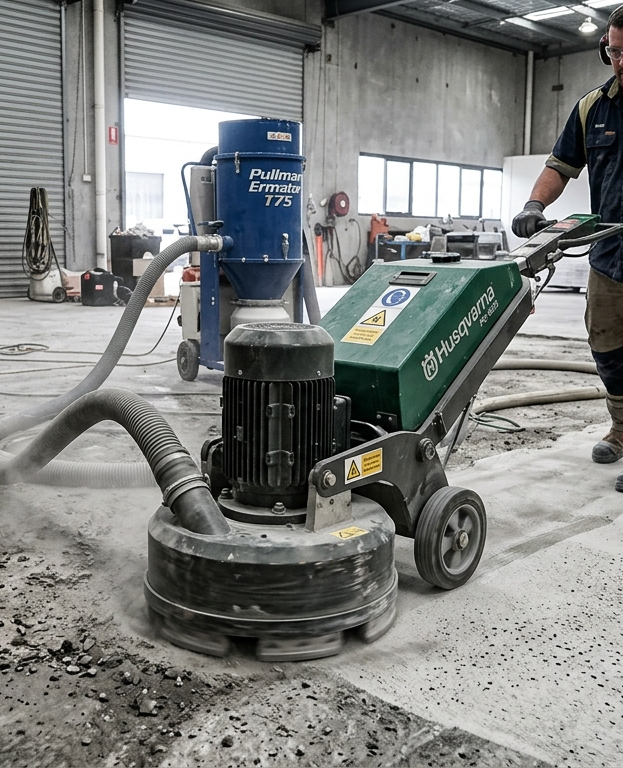
Polished concrete works by mechanically grinding and refining an existing concrete slab to achieve a smooth, dense, and highly reflective surface. A key step in this process is densification, where a chemical hardener is applied to the slab to fill pores and react with the concrete matrix. This process increases surface hardness by 40 to 60%, making the floor significantly more resistant to abrasion and surface wear.
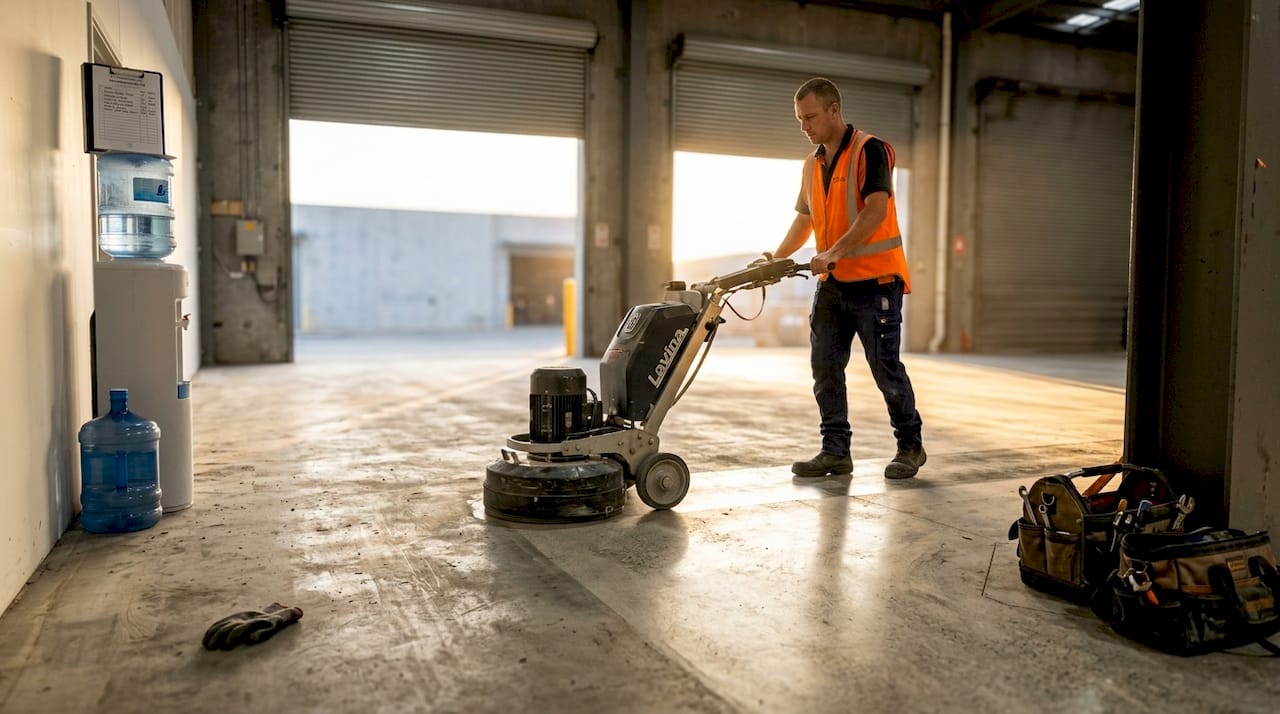
The result is a floor that can realistically last 20 years or more with very little intervention. For a busy Queensland warehouse or logistics facility, that kind of longevity translates directly into lower total cost of ownership. You’re not scheduling downtime for recoating every few years. You’re simply cleaning the floor and getting on with business.
Key strengths of polished concrete for industrial use:
- Exceptional lifespan: A properly prepared and polished slab regularly exceeds 20 years of service life
- Low maintenance: Routine sweeping and occasional mopping is all that’s typically needed
- No coatings to fail: Unlike epoxy, there’s no topcoat that can peel, chip, or delaminate
- Improved light reflectivity: The high-gloss finish can reduce the need for artificial lighting in large spaces
- Lower environmental footprint: No chemical coatings means fewer VOC emissions and less waste
- Modern appearance: Clean, minimal, and professional aesthetic that suits a wide range of commercial settings
For polished concrete in warehouses, the practical benefits are hard to argue with. The surface is easy to clean, resists tyre marks from forklifts, and holds up under constant heavy traffic without showing the wear patterns that coated floors often develop.
There are limitations to be aware of. Polished concrete is not the right choice for areas with frequent chemical spills, particularly acids or strong solvents, because the surface, while dense, is still porous at a microscopic level and can absorb aggressive substances over time. It also requires a structurally sound slab to begin with. Cracked or contaminated concrete needs remediation before polishing can achieve a quality result.
For a thorough breakdown of what this process involves and what results to expect, our concrete polishing guide covers the full process from surface preparation through to final finish. You can also explore the polished concrete benefits that make it a strong long-term investment for Queensland facilities.
Pro Tip: If your slab has minor surface damage or contamination, ask your flooring contractor about diamond grinding and repair options before ruling out polished concrete. Many slabs that appear unsuitable can be restored to a polishable condition with the right preparation.
Epoxy coatings: Chemical-proof and visually versatile
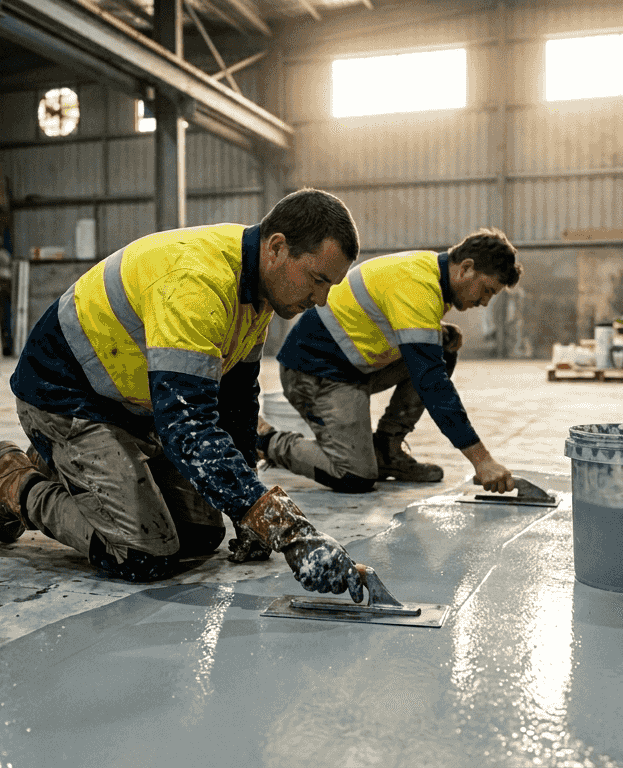
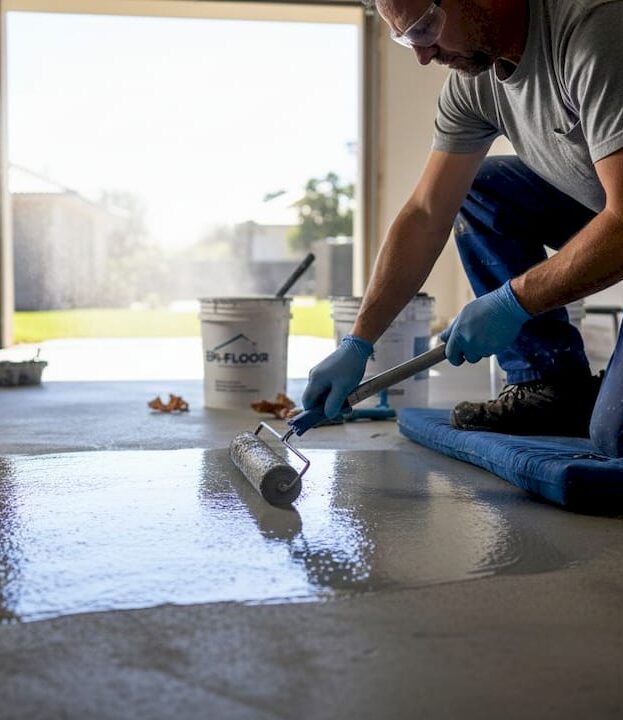
While polished concrete shines in longevity, some industries need more chemical or impact protection. That’s where epoxy coatings excel. Epoxy is a resin-based coating system applied over a prepared concrete substrate. It bonds tightly to the slab and cures into a hard, seamless surface that resists a wide range of chemicals, oils, and physical impacts.
For manufacturing plants, food processing facilities, automotive workshops, and medical or pharmaceutical spaces, epoxy is often the preferred choice. The surface can be formulated to meet specific hygiene standards, resist particular chemical compounds, and withstand the kind of heavy impact loading that would damage less robust systems.
Epoxy coatings offer one of the most versatile performance profiles available in industrial flooring, combining chemical resistance, load-bearing capacity, and aesthetic flexibility in a single system.
Key strengths of epoxy floor coatings for industrial use:
- Superior chemical resistance: Formulated to resist oils, acids, alkalis, and cleaning agents
- High impact tolerance: Handles dropped equipment, heavy machinery, and point loads effectively
- Seamless and hygienic: No joints or grout lines where bacteria can accumulate
- Aesthetic range: Available in solid colours, decorative flake systems, and metallic finishes
- Fast installation: Can often be applied and returned to service within 24 to 72 hours
- Slip resistance options: Anti-slip aggregates can be broadcast into the topcoat during application
The epoxy floor coatings we install are specified to match the demands of each facility, whether that’s a food-safe finish for a commercial kitchen or a heavy-duty system for a manufacturing floor. Our solid colour epoxy floors are a popular choice for businesses wanting a clean, professional look with consistent colour across the entire surface.
The main limitation of epoxy is its lifespan relative to polished concrete. Epoxy typically needs recoating every 5 to 10 years in high-use industrial environments. Each recoat involves surface preparation, downtime, and cost. In facilities running continuous operations, scheduling that downtime is a real logistical challenge.
UV exposure is another consideration in Queensland. Standard epoxy can yellow or chalk when exposed to direct sunlight, so external or semi-external areas require a UV-stable polyurethane topcoat to maintain appearance over time.
Pro Tip: For facilities with mixed-use zones, consider specifying polished concrete in dry, high-traffic corridors and epoxy in chemical or wet process areas. This hybrid approach delivers the best performance in each zone without overspending on a single system throughout.
Polished concrete vs. epoxy: Direct comparison for Queensland businesses
To make an informed choice, it’s critical to see how these two leading options match up side by side. Empirical benchmarks show epoxy at 10 to 20 years and polished concrete at 20 or more years, with contrasting advantages depending on the application.
| Feature | Polished concrete | Epoxy coating |
|---|---|---|
| Lifespan | 20+ years | 10 to 20 years |
| Upfront cost | Moderate to high | Moderate |
| Lifetime cost | Lower overall | Higher due to recoating |
| Chemical resistance | Moderate | Excellent |
| Maintenance | Minimal | Periodic recoating required |
| Aesthetic options | Natural, high-gloss | Wide colour and texture range |
| Environmental impact | Low | Moderate (VOCs during install) |
| Best for | Warehouses, logistics, retail | Manufacturing, food processing, medical |
| Slip resistance | Additive required | Additive available |
| UV stability | Stable | Requires UV-stable topcoat |
When to choose polished concrete:
- High-traffic dry areas such as warehouses, distribution centres, and retail floors
- Facilities prioritising low maintenance and long-term cost efficiency
- Spaces where natural aesthetics and light reflectivity are valued
- Operations that cannot afford frequent recoating downtime
When to choose epoxy:
- Areas with regular chemical spills, oil exposure, or wet processes
- Food production, pharmaceutical, or medical environments requiring seamless hygienic surfaces
- Facilities wanting maximum decorative flexibility with colour coding or branded finishes
- Workshops and manufacturing plants with heavy impact and abrasion demands
For Queensland businesses evaluating best garage flooring options or commercial spaces, the decision often comes down to what your floor faces daily. Neither option is universally superior. The right choice depends on your specific operational environment, chemical exposure, and how much maintenance disruption your business can absorb.
Why most businesses overlook lifetime cost when choosing floors
Now that you have a clear comparison, let’s address a critical mistake often made in the selection process. In our experience working with Queensland businesses across a range of industries, the single most common error is choosing a floor based on the lowest installation quote rather than the lowest cost over the life of the building.
It’s understandable. Capital budgets are tight, and a lower upfront number is easy to justify. But a lower lifetime cost, such as approximately $165,000 over 20 years for a 5,000 square metre polished concrete floor compared to significantly more for repeated epoxy recoating cycles, tells a very different story when you run the full numbers.
Queensland’s operational climate amplifies this. High humidity accelerates coating degradation. Busy facilities have limited windows for maintenance shutdowns. Every recoating cycle means lost productivity, contractor fees, and the risk of substandard adhesion if the surface preparation isn’t thorough.
We consistently recommend that facility managers request a 20-year cost model before committing to any flooring system. Factor in recoating frequency, surface preparation costs, and business downtime. The floor that looks expensive on day one often proves to be the most economical choice by year ten. Explore the lasting value with polished concrete to see how this plays out in real Queensland facilities.
Ready to upgrade? Expert help for industrial floors in Queensland
To implement the best choice for your facility, expert guidance can ensure you get the durability and style that fit your business. At FloorX Industries, we work with Queensland businesses to assess their specific needs and recommend flooring systems that deliver long-term performance, not just a good-looking install on day one.
Whether you’re considering epoxy floor coatings for a chemical-intensive environment or exploring concrete polishing for a high-traffic warehouse, our team brings over a decade of hands-on Queensland experience to every project. We provide site assessments, detailed quotes, and tailored recommendations based on your floor’s condition, your operations, and your budget. Read our warehouse polished concrete advice or contact us today to arrange a consultation and take the guesswork out of your next flooring decision.
Frequently asked questions
What is the most durable industrial flooring option for heavy traffic?
Polished concrete is generally the most durable and cost-effective option for high-traffic industrial areas, with a lifespan exceeding 20 years and surface hardness significantly increased through densification. Its resistance to abrasion and low maintenance requirements make it the preferred choice for warehouses and logistics facilities.
How often do epoxy floors need to be recoated in industrial facilities?
Epoxy floors typically need recoating every 5 to 10 years in industrial environments, depending on traffic intensity and chemical exposure. Facilities with heavy daily use or frequent spills will generally reach the lower end of that range.
Are polished concrete floors slippery when wet?
Polished concrete can be slippery when wet, but anti-slip additives or textured finishes can be incorporated during installation to significantly improve traction. We always assess slip risk as part of our surface specification process.
Which flooring is more cost-effective over 20 years?
Polished concrete typically delivers better overall value over a 20-year period, with a lower lifetime cost when recoating cycles, surface preparation, and business downtime are factored in. Epoxy may have a lower upfront cost but accumulates higher ongoing expenses in high-use industrial settings.